
LORENZO SALGADO ARAUJO
The American Dream Shot Dead


He got up at 5:50 in the morning. Every morning, for thirty-five years, in a country that spent the last one hunting him.
That’s the whole story, if you want it in one sentence and you don’t have time for the rest. But you should make time. Because somewhere between the alarm clock and the sidewalk where he bled out screaming, there’s a version of America worth being furious about, and I’m not going to spare you a single detail of it.
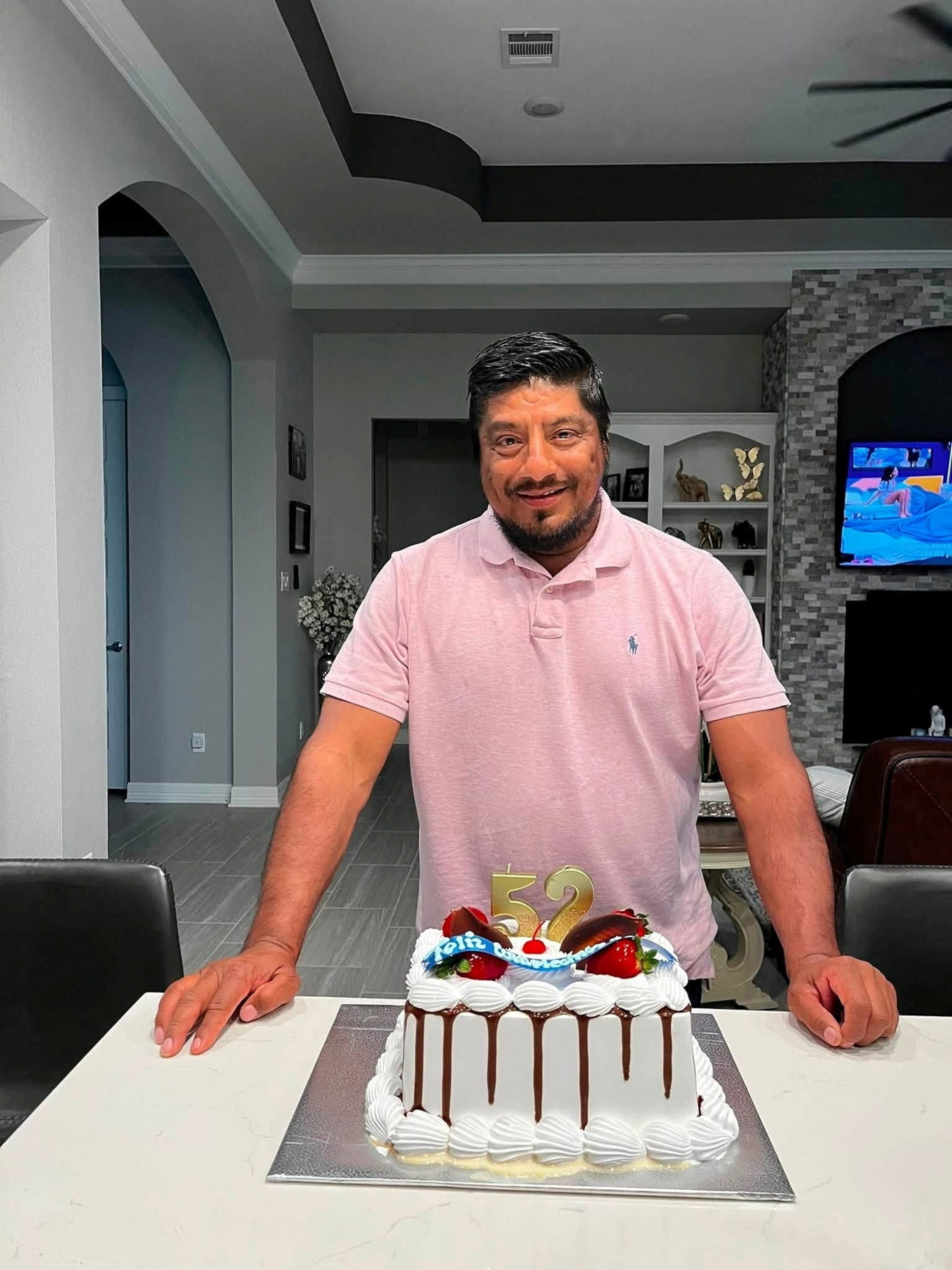
His name was Lorenzo Salgado Araujo. Fifty-two years old. Mexican-born, Houston-built. He’d been in this country longer than some of the agents who killed him have been alive. He ran his own construction crew — a real one, a builder, the kind of man who drove other men to job sites before the sun was up and made sure they got paid. The men who worked for him called him el mundo entero. The whole world. Write that down. Underline it. That’s not a nickname you get from being ordinary.
On Tuesday, July 7th, he did what he’d done every working day since before some of you reading this were born. He kissed his wife. He climbed into his white work van. He drove to collect his crew — three men, including his own brother — to go build something. That’s it. That’s the crime. That’s the entire manifest of wrongdoing Lorenzo Salgado Araujo was guilty of on the last morning of his life: he went to work.
They weren’t even after him.
ICE had a tip on two Guatemalan men. They’d been watching an address for weeks. They’d noted two white vans in the vicinity. On the morning in question, an agent glimpsed a white van with a driver who “resembled” the man they wanted, and that — a resemblance, a passing glance through a windshield, the loosest currency of justice this government still accepts — was sufficient probable cause to send two unmarked black SUVs howling through a residential neighborhood at 6:50 a.m. after a work van full of laborers.
No lights. No sirens. No markings. Just government vehicles playing chicken with a man’s morning commute.
Surveillance video — and there’s a lot of it, because the East End is not short on doorbell cameras and shop-front lenses, God bless every bodega owner who ever wired one up — shows the chase. Shows an ICE SUV driving on the wrong side of the road through a construction zone to cut him off. Shows the van stopping, then reversing, then rolling slow onto a sidewalk while agents ran alongside on foot. What the video does not show — what no video anywhere shows, and there are hours of it — is Lorenzo Salgado Araujo ramming a federal vehicle. It does not show him trying to run down an agent. The one piece of footage that would settle this whole ugly argument, the actual half-second when the trigger got pulled, simply isn’t there. Nobody has it. Or nobody will give it up.
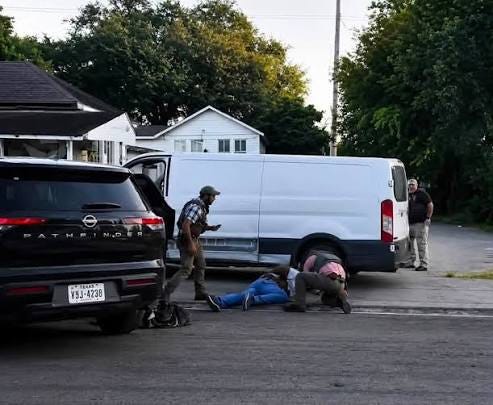
Their story — the one they’ve now told three different ways, according to the county’s own district attorney, who said publicly that their account “has moved a number of times since Tuesday morning” — is that an agent fired because he feared being run over. Run over by what, exactly, if the bullet went in on the side of the vehicle facing away from the direction it would need to be moving to run anybody over? A former U.S. Secret Service agent, brought in by a local news station to review the tape with zero horse in this race, looked at that detail and said the quiet part plainly: it complicates the narrative. It changes the perspective. That’s a professional being polite about the fact that the physical evidence doesn’t fit the government’s alibi.
No body camera caught the moment. Of course it didn’t. DHS says the agents in that field office hadn’t been issued cameras yet — blame the shutdown, blame the budget, blame anything except the possibility that the one unbiased witness to a killing happened to be conveniently, permanently absent. You want to know what kind of institution kills a man and then explains away its own homework? This kind.
A woman named Juliet Martinez heard what the cameras couldn’t show her. She was nearby. She filmed what came after — Lorenzo, face-down on the pavement outside a barbershop, the right side of his stomach open and bleeding, screaming that he’d been shot, screaming for somebody to help him — while the agent who’d just fired knelt over him. On the phone. Reporting the incident. Not applying pressure to the wound. Not holding his hand. Filing the paperwork on a man before anyone had confirmed there was still a pulse to save.
The three other men in the van — his crew, his brother among them — were zip-tied and disappeared into the machinery of immigration detention before anyone thought to tell them whether the boss they rode in with had lived or died. His son didn’t get a phone call from the government that killed his father. He got a stranger’s video, autoplaying on a feed, and he recognized the man on the ground before anybody in a federal uniform bothered to confirm it for him. Twenty-nine years old. A schoolteacher. Finding out his father is dead the way you find out a celebrity died — scrolling, cold, alone.
Thirty-five years of staying quiet, staying employed, staying useful. Filling out the paperwork this country insists on pretending is available to everyone who “does it right.” Every form. Every appointment. His son stood in front of a bank of cameras three days after the shooting and said it plainly, voice cracking: we dotted every I, crossed every T, filled every document, attended every appointment. He was close. He was this close to legal status, three decades deep into building somebody else’s American dream, when a government agent shot him over a case of mistaken identity in a van he wasn’t even the target of.
The Harris County Medical Examiner didn’t soften it for anybody. No euphemism, no “officer-involved incident.” One word, on an official document, under oath: homicide.
And still, days later, the agency responsible won’t release the shooter’s name. Won’t release the van. Won’t grant local investigators access to the scene. The county DA said he’s getting updates on a killing “via X and Twitter” — that a man died and the government’s idea of transparency is a social media post. He’s threatened to go to a judge for a warrant just to get access to a vehicle that belongs, in every meaningful sense, to a dead man’s family and to the truth.
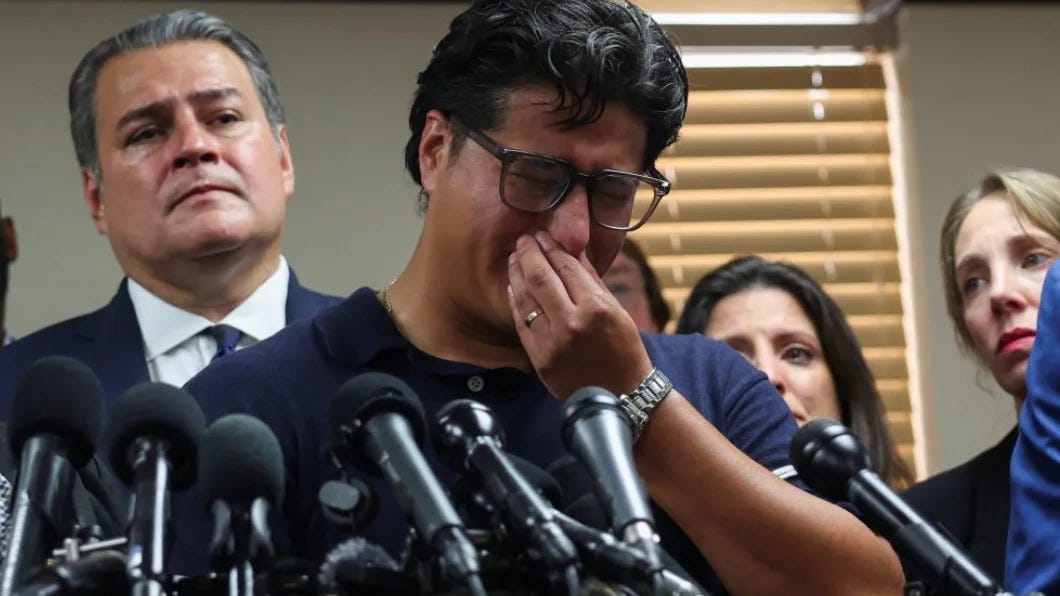
This is not a headline. His son said as much, through tears, in a press conference I hope every one of you watches in full: he did not deserve to be reduced to a headline of “Mexican man shot and killed by ICE.” He deserved a porch. He deserved to watch his sons finish what he started. He deserved to grow old loud and unremarkable in a country he’d spent thirty-five years quietly building with his own two hands.
Instead he is a homicide file. A victim in a story that keeps changing shape. A name the government still hasn’t fully reckoned with, attached to a shooter whose name they still won’t say.
Lorenzo Salgado Araujo. El mundo entero. Say it. Don’t let them shrink him down to a case number, because that shrinking is the whole design — that’s how a government gets away with killing a man over a resemblance, by making sure you never learn his name long enough to be angry about it.
Be angry about it. Stay angry about it. That’s the only appropriate temperature for a government that shoots its citizens dead in the street, aiming at the wrong assumptions, and then spends the following week arguing about who gets to see the footage.
Say his name.
Lorenzo Salgado Araujo.
This is so sad I don't even know what to say. I am also very, very angry.
Say the names of every soldier who died in the unnecessary USA wars during the last century!