
SYBIL RODE ALONE
Real Heroes Don't Wait for Recognition


She had no poem, no lanterns in the tower. Just a horse, a stick, and a reason to ride.
Most of us know the story of Paul Revere. Or at least the sanitized, rhymed, and whitewashed version — the one polished into textbooks and elementary school plays, where a brave man rides into the night with a lantern-lit warning and a destiny carved in copper.
But here’s the thing they don’t teach you:
He was caught.
He didn’t finish.
And two years later, a 16-year-old girl named Sybil Ludington rode twice as far through hell and back — and history barely left her a footnote.
THE GIRL WITH THE STICK
It was April 26, 1777. Two years after Lexington and Concord. The British were burning Danbury, Connecticut. The militia was scattered, planting fields for spring. Someone had to gather them.
The courier who brought the news to Colonel Henry Ludington had no horse left to ride. The men were too far, too spread out. And so the colonel turned to his daughter — Sybil, the eldest of twelve children. A teenager. A farm girl. A spy’s daughter. A patriot.
She rode into the rain, into Loyalist territory thick with outlaws and British sympathizers. She rode alone, through towns and woods and night-black roads. No sword. No musket. Just a wooden stick she used to pound on doors — and, reportedly, on the head of a Skinner who tried to stop her.
Forty miles. Through storm and darkness. Alone.
By dawn, she had returned. The men were already mustering at her father’s farm, ready to march on Ridgefield. She’d done it. She didn’t need a poem. She needed no applause. She just got on the horse and rode.
THE COST OF MYTH
Revere had Longfellow.
Sybil had silence.
No “one if by land, two if by sea.” No copperplate portraits. No elementary school murals. Just a grave with her name misspelled and a handful of weather-stained monuments built long after anyone who remembered her had died.
This is what history does — it erases the girls, sands down the legends that don’t fit the mold, and hands the spotlight to the man with the marketing.
Sybil rode harder.
She rode farther.
She rode alone.
And then she vanished into the margins.
THE REAL HEROES DON’T WAIT FOR RECOGNITION
Sybil’s ride wasn’t about credit. It wasn’t about fame or medals or myth. It was about duty — that raw, unpolished sense that when something needs to be done, you do it, whether or not anyone remembers your name.
She never claimed greatness. She married, had a child, ran a tavern, and lived out her life mostly as a widow. No school named in her honor. Just a legacy passed in whispers, revived now and then by history nerds and local preservationists and women tired of being erased.
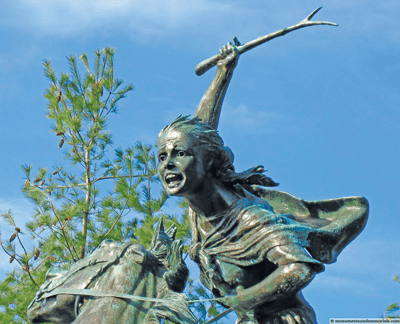
But make no mistake: Sybil Ludington is exactly who this country was built on.
Not the speech-givers.
Not the flag-wavers.
Not the armchair generals.
But the girl in the rain with a horse and a stick and no backup.
THIS IS WHO THEY NEVER WANT YOU TO BECOME
You want to know why Sybil isn’t a household name?
Because she's dangerous.
A teenage girl defying Loyalists. Outriding the founding fathers. Outlasting the weather. Doing what the men couldn’t, wouldn’t, or didn’t.
That’s not the kind of story empires like to tell.
That’s the kind of story that sparks rebellion — the kind that makes other people get on the damn horse, too.
So here’s your history lesson:
Revere got the poem.
Sybil got the job done.
And here’s your homework:
Be like Sybil.
Ride anyway.
Alone if you have to.
Armed with nothing but purpose and a stick.
And if they try to forget you — make sure the world you leave behind is too loud to ignore.
That was very interesting! My thanks 🙏
That was a great story to celebrate Women’s Day, but I did ask Google Gemini why the history was never corrected in all Elementary books? Did a poet get to falsify the historical facts because of cadence in a poem?
Here is what Google AI tool said tonight:
“Longfellow’s Poetry: Paul Revere's legendary status is largely due to Henry Wadsworth Longfellow’s 1860 poem, "Paul Revere's Ride," which took significant creative liberties—such as omitting the other riders (William Dawes and Samuel Prescott) and ignoring that Revere was captured—to create a simple, rhythmic national myth.”
“Ludington as a "footnote": While she was long ignored, she has gained significant recognition since the mid-20th century as a feminist icon. She has been honored with a U.S. postage stamp (1975), several statues, and an annual 50k footrace.
Would you like to see a comparison map of the actual routes taken by Revere, Dawes, and Ludington to see how their distances and paths differed?”
I said No.