
THE REAL FRAUD
Nick Shirley, MAGA outrage culture, and the strange silence around the largest pandemic grift in American history


There are few sounds more American in 2026 than a MAGA influencer standing in front of a camera, eyes blazing with righteous fury, demanding accountability for fraud while the charred skeleton of the Paycheck Protection Program smolders quietly behind him like a warehouse fire everyone agreed not to investigate too hard.
“Fraud!” they scream.
Yes. Correct. There was fraud. An astonishing amount of it.
The federal government estimates roughly $64 billion in potentially fraudulent PPP loans alone. Broader pandemic relief fraud estimates climb north of $200 billion. That is not corruption in the abstract. That is an entire parallel economy built out of fake LLCs, invented employees, strip-mall accounting firms, and men named Chad buying lifted pickup trucks with “payroll protection” money while insisting they are rugged individualists. America essentially threw cash from helicopters during COVID because the alternative was economic collapse. Some of that money genuinely saved restaurants, payrolls, and small businesses. Some of it purchased jet skis for people whose “consulting company” operated out of a mailbox next to a vape store in Tampa.
And yet somehow, mysteriously, almost magically, the people who spent years treating PPP fraud like an unfortunate side effect of emergency governance suddenly rediscovered moral outrage the moment the word “Minnesota” entered the conversation. Now fraud was the defining crisis of the republic. Now every daycare was a potential criminal enterprise. Now every Somali nonprofit became evidence that civilization itself was under attack.
Curious.
Because the Minnesota fraud cases are real. Feeding Our Future was real. Roughly $250 million allegedly stolen from child nutrition programs is not a hallucination cooked up in a Facebook comment section at two in the morning. Federal prosecutors brought cases. Convictions happened. Money disappeared into shell organizations and fake meal counts while pandemic-era oversight systems buckled under pressure.
That happened.
But here is where the fraud conversation itself becomes fraudulent.
PPP fraud was roughly two hundred and fifty-six times larger than Feeding Our Future. Two hundred and fifty-six. That is not a discrepancy. That is the distance between a backyard kiddie pool and the Atlantic Ocean. Yet MAGA media talks about Minnesota like it was the financial equivalent of the asteroid that killed the dinosaurs while PPP fraud gets treated like an unfortunate accounting hiccup that accidentally resulted in somebody buying a Range Rover with taxpayer money.
Why?
Because PPP fraud implicates the mythology America worships. PPP fraud involved “job creators,” business owners, lenders, financiers, entrepreneurs, and every sacred LinkedIn sociopath who believes opening an LLC makes them Ayn Rand with a Bluetooth headset. Minnesota fraud, meanwhile, could be packaged into something emotionally and politically useful. It could be urban. It could be immigrant. It could be Somali. It could be Democratic. It could be transformed into a full-spectrum panic attack about blue cities and “woke corruption.”
The outrage machine saw a narrative sitting unattended on the sidewalk and stole it like a catalytic converter.
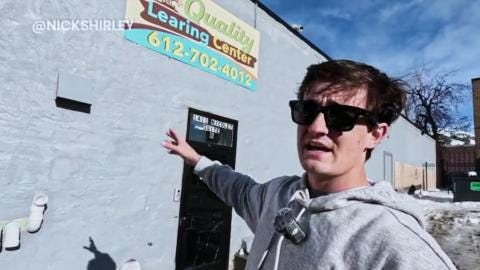
Which brings us to Nick Shirley, a man who has built a thriving media career on filming himself walking toward ambiguity while dramatic music plays underneath. Nick Shirley did not invent Minnesota fraud. That would actually be easier to debunk. What he did instead was more subtle and, frankly, more dishonest.
He weaponized atmosphere.
That is the trick.
Take a real scandal. Wrap it around unrelated footage. Add ominous narration. Film locked doors. Ask loaded questions. Treat refusal to cooperate with a random YouTuber carrying a camera like proof of guilt. Let viewers emotionally connect dots the evidence never actually connected. In Shirley’s daycare videos, empty hallways became evidence. Closed offices became evidence. People refusing access to children became evidence. The implication floated over every frame like cigar smoke in a backroom poker game.
Later reporting complicated much of the narrative. Multiple outlets found children present at many of the centers highlighted in his videos. Direct evidence supporting some of his broadest insinuations simply was not there. But by then it no longer mattered because the algorithm had already swallowed the narrative whole and moved on to its next emotional support conspiracy.
That is not journalism.
That is vibe laundering.
And now comes Cuba, because every influencer eventually reaches the stage where they begin imagining themselves either as a persecuted dissident or the lead character in a low-budget espionage thriller. Nick arrived in Cuba and quickly began describing spies, danger, surveillance, generals waiting in hotel lobbies, possible hostage situations, and escape routes to the U.S. Embassy. Which sounds incredibly dramatic until another guy named Zach apparently wandered over to the same hotel with a cellphone and started filming people casually eating dinner outside.
That man deserves some credit.
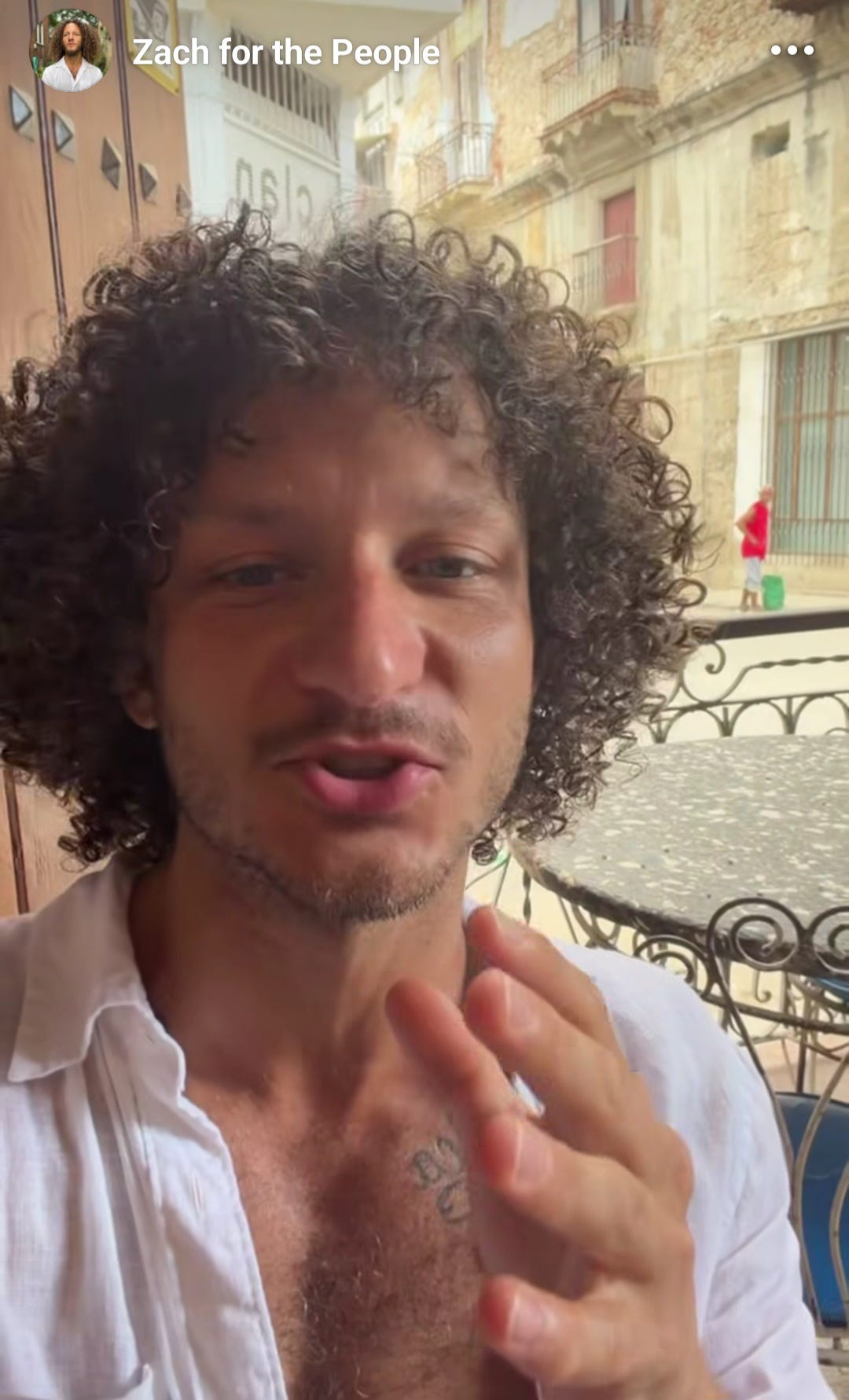
Zach Metzger, better known online as Zach for the People, did something increasingly rare in modern political media: he physically went to the location in question and tested the narrative against observable reality. His footage did not prove Cuba is free or democratic. Cuba absolutely surveils dissidents and foreign political content creators. But Zach’s videos punctured the cinematic mythology Shirley was constructing around himself. No visible siege. No hostage atmosphere. No panicked evacuation scene. No trembling dispatch from a hidden bunker beneath Havana. Just another hotel courtyard with tourists, lights, and people trying to eat dinner in peace while two American content creators conducted an ideological cage match for social media engagement.
And this is the real fraud story.
Not merely stolen money. Stolen perception.
America has entered an era where narrative itself is the grift. PPP scammers forged payroll documents. Influencer propagandists forge emotional certainty. Both understand the same fundamental truth: if you move fast enough, yell loudly enough, and trigger the correct fears, most people will never stop to audit the books.
MAGA wants to talk about fraud?
Excellent.
Let’s talk about the $64 billion PPP disaster. Let’s talk about fake businesses vacuuming up taxpayer money while the same political movement now screaming about Minnesota voted to blast pandemic money out the door with minimal oversight. Let’s talk about fintech lenders rubber-stamping loans like drunken blackjack dealers at three in the morning. Let’s talk about why white-collar pandemic fraud became background noise while every Somali-run nonprofit in Minneapolis became a national morality play.
And let’s talk about influencers who discovered that outrage itself is a business model. Because Nick Shirley may not be a financial fraudster, but narrative fraud is still fraud. Dressing implication up as evidence is fraud. Manufacturing panic from ambiguity is fraud. Turning vibes into accusations is fraud.
America became so obsessed with catching scammers that it accidentally turned scamming into the dominant communication strategy of the age.
Which, honestly, feels about right.
Selective outrage is the cousin, or perhaps forebear, of scam communications. PPP fraud is real, but Nick Shirley is full of shit.
Very enlightening! Great information!