
WHEN I FIRST MET KEITH ELLISON


Although I believe it's one of the most beautiful cities on Earth, I did not drive to Duluth for the scenery.
On June 19th, 2018, I drove to Duluth, Minnesota because the Trump administration was separating children from their parents and putting them in cages, and staying home felt morally wrong. Staying quiet felt complicit. Trump was coming to Duluth the next day for a rally. There was going to be a large protest and I intended to be part of it.
A roll of paper five feet tall and twelve feet long coiled in my backseat like a sleeping giant who had not yet been informed of its purpose. Also, dozens of markers. The good ones. A volume of markers that suggested either visionary optimism or a clinical inability to think past the moment of acquisition. Enough markers to outfit a small and extremely opinionated army.
I drove three hours north until I reached the shore of the largest freshwater lake in the world. Lake Superior definitely doesn’t care — Lake Superior has been here ten thousand years, has eaten ships whole, has opinions about nothing except the ice and the wind and the particular foolishness of human beings who think they understand large bodies of water. Lake Superior was not going to be moved by a presidential rally. Lake Superior was not going to be moved by anything.
I found that comforting.
Bayfront Festival Park. The air had that pre-something charge — not calm, not chaos, the held breath of a crowd still deciding what kind of day it was going to be. I looked at the stage. The stage had space on it. Space is an invitation if you’re the kind of person who takes invitations that haven’t technically been extended, which I am, which is why I was in Duluth with twelve feet of paper instead of home watching this on television like a reasonable adult.
I unrolled the paper across the stage and the paper immediately tried to re-roll itself, because paper has no ideology and no commitment to the cause, and this is a metaphor I am choosing not to pursue.
People materialized. This is what happens with large paper and good markers — people appear, drawn by some primal instinct to participate in the making of a large thing. Someone tested a marker on their palm. Someone else picked up a blue one and then put it down and picked up a red one and then put it down and stood there radiating indecision. Someone argued about font. There is always someone who argues about font. I have decided that when civilization finally collapses, the last sound will be two people arguing about whether the warning sign should be in Helvetica or Impact.
I started lettering.
Big. No ambiguity. No hedging. The full commitment of someone who drove three hours and is not here to whisper.
F%CK TRUMP
The percent sign was doing more work than its two keystrokes deserved. That tiny, absurd, completely see-through fig leaf — the thinnest possible membrane between a message and the message — made the whole thing sharper somehow. Not softer. Sharper. The kind of workaround that conceals nothing and dares you to pretend otherwise, and in the daring becomes something more than the original would have been without it.
I was finishing the last letter. Marker in hand. Ink still wet. The thing nearly done.
Someone tapped my shoulder.
I turned around.
It was Keith Ellison.
Congressman. Future Attorney General. Currently existing in that strange political purgatory where the next version of yourself is actively assembling while the current version is still technically on duty and receiving a salary. He had the look of a man who has shaken ten thousand hands at ten thousand events and arrived at this one with no particular expectations, which was about to be the correct attitude to have.
He looked at the sign.
He looked at the percent sign.
He looked at me.
“What does that spell?”
Now.
I want you to understand the situation. The word is not ambiguous. It has not been ambiguous for the entire duration of its existence as a word. Every single person within visual range of this sign has understood it completely for the past forty-five minutes. The percent sign was a legal technicality written in marker on paper in a public park and it was not, is not, and never will be fooling anyone about anything.
I told him there was simply no way to know, due to the percent sign.
He looked at me.
I looked at him.
The moment expanded. Time did the thing it does when two people are deciding simultaneously whether to acknowledge the reality of a situation or to honor a premise that both of them understand to be insane. It is a negotiation conducted entirely without words.
He told me he was leaving Congress because getting anything done there was beyond frustrating — that the whole structure was built to absorb effort and produce the appearance of motion without the reality of it, and he thought he could do more as Attorney General. He said it the way people say things when they have stopped performing the answer and are just giving it. No packaging. No message discipline. Just a man who had been inside a machine long enough to know exactly what it was capable of and what it wasn’t, and had made a decision accordingly.
I told him I thought Ilhan Omar would do a great job replacing him.
He smiled. Not a politician smile — not the full-wattage thing deployed at fundraisers and county fairs. A real one. The smile of a man who already knew that, had known it for a while, and was genuinely glad that the thing he was leaving was going to be in good hands.
Then he reached down and picked up a purple marker.
Minnesota purple. Prince purple. The purple of ten thousand frozen January mornings and a football team that has broken the hearts of an entire region in ways so creative and so varied that the heartbreak has become a kind of identity, a thing people from here carry with them and somehow treasure. He picked up that marker and he colored in the K.
Carefully.
Deliberately.
Like it was the most natural thing in the world.
One letter. Not a statement. Not a gesture. Just: a letter that needed filling in, and a man who filled it in, and the complete absence of any apparent internal debate about whether this was something a person in his position ought to be doing.
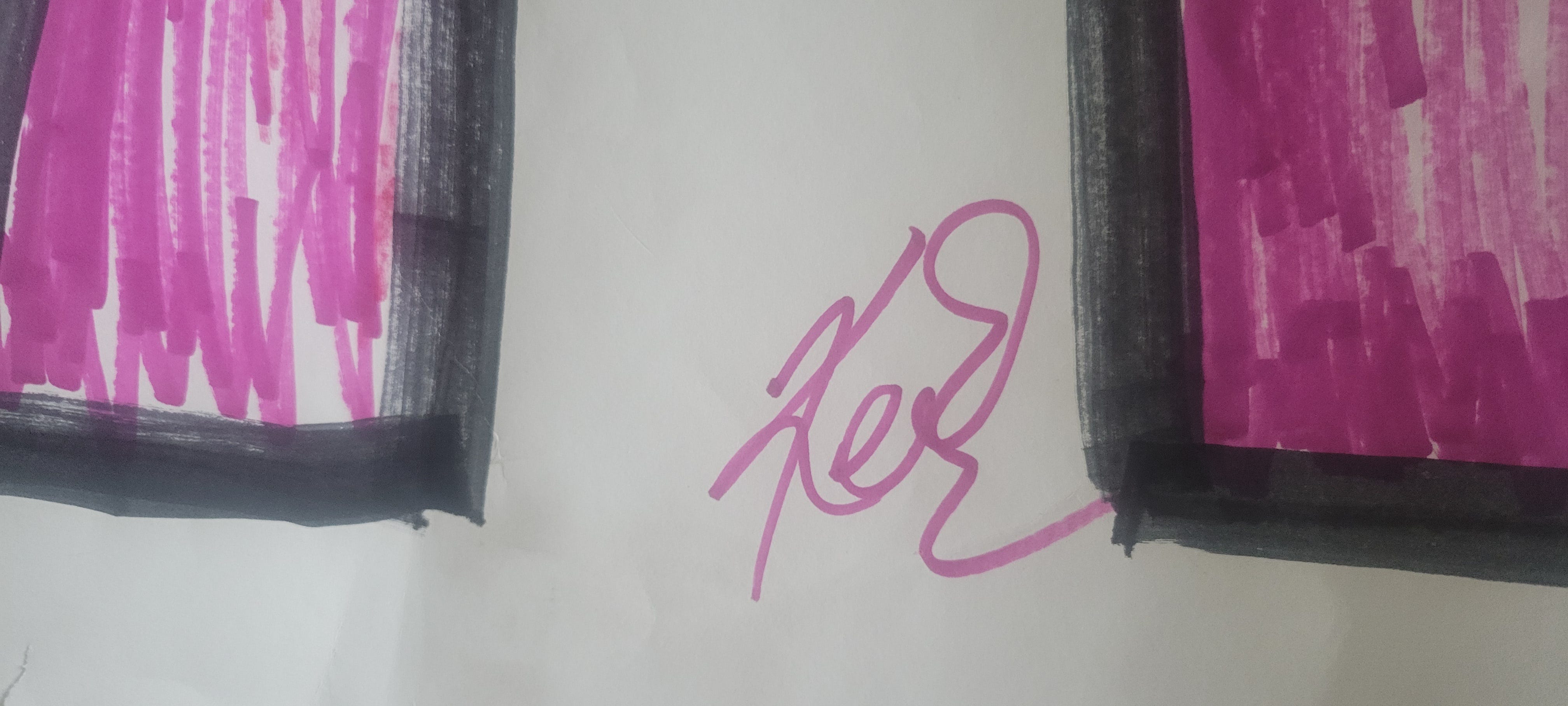
Then he signed his name. Right there on the banner. His actual name. Full signature. The penmanship of a man who signs things for a living and was applying that skill to a twelve-foot semi-censored profanity poster the day before a presidential rally, because that is apparently who Keith Ellison is, and I mean that as the highest possible compliment.
He left.
The wind came off Superior and lifted the edges of the banner and I held it down because you do not drive three hours with twelve feet of paper and let the lake steal the ending.
The letters dried. The ink set. And there in the grain of that magnificent, deranged document was the complete record of the encounter: one filled-in K, one signature, one act of absolute commitment to a premise a man had encountered thirty seconds before and decided, without visible hesitation, to honor fully.
Trump signed an executive order the next day purporting to end family separations. This is what power does when it has done something indefensible and needs you to feel like it’s over — it hands you a piece of paper. It calls the paper mercy. It does not mention that you cannot undo what has already been done to a child’s nervous system with a pen stroke, cannot reach back into the detention facilities and un-ring the bell of what those kids learned about what this country thinks of them and their parents.
Eight years later Keith Ellison is in front of cameras making the federal government answer questions under oath with consequences attached, and the federal government is doing what it always does when forced into accountability: stalling, classifying, citing procedures, hoping you get tired before it does.
It picked the wrong Attorney General.
On March 28, at the Minnesota State Capitol, there’s a massive No Kings rally planned.
Keith Ellison will be there. You should be too.
Great story. All the very best for No Kings this Saturday, hope it’s many, many millions. 💖from Australia.
Thank you for this wonderful story of engagement and hope.Am I the only reader who had to check the relationship of Keith Elllison to Larry Ellison? After all, both prominent. In the headlines. Must be somewhere in their family tree. Alas, and gratefully, there is no link, just a similarity of last names. Keith Ellison is an American politician and lawyer, serving as the 30th Attorney General of Minnesota. Larry Ellison is an American businessman and investor, best known as the co-founder of Oracle Corporation. Keith is African American. Larry Ellison is considered a supporter and ally of Donald Trump. 'Nuff said. Keith deserves our admiration. Not only inserting the essential letter to the sign, but performing his duties in the service of his constituents. Larry is a jerk. In a friendship likely strategic, rather than honesty. As you, I'm grateful you met the REAL AMERICAN Ellison. The other one can go f%*k himself.