
SMITH’S DEPOSITION AND TRUMP’S DISABILITY


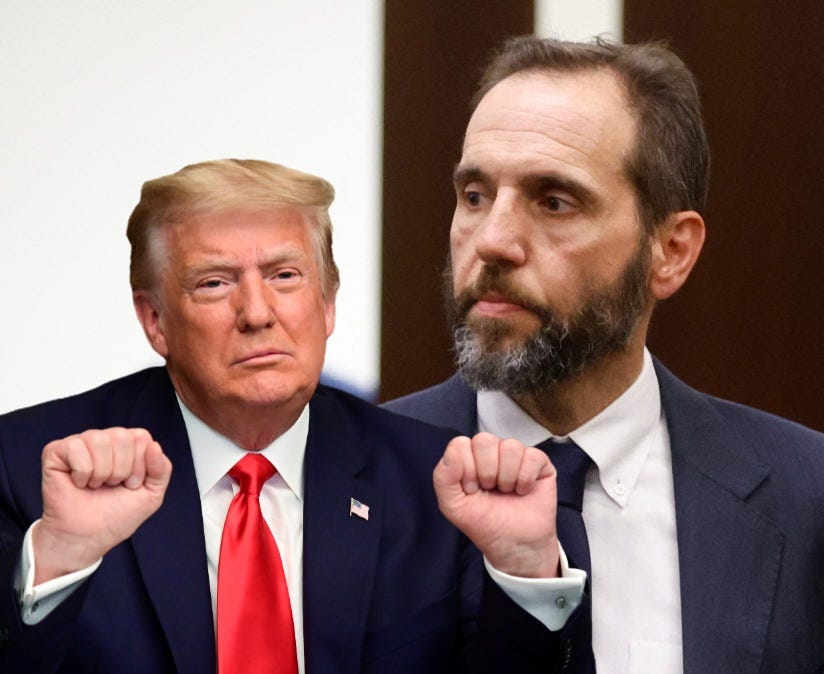
Jack Smith did not walk into his deposition like a man pleading his case. He walked in like a man filing the paperwork for history. Calm, precise, almost aggressively boring in tone, Smith delivered 255 pages of sworn testimony that read less like political drama and more like a coroner’s report. No flourish, no bravado, no cable-news bait. Just facts, causation, and law. And buried in that monotone, devastating record is a conclusion that many institutions are still pretending they cannot see. Donald Trump is constitutionally disabled. Not metaphorically. Not rhetorically. Legally.
Smith’s testimony stripped January 6 of its remaining excuses. He did not describe it as chaos or tragedy or even extremism. He described it as consequence. He stated, under oath, that the attack on the Capitol does not happen without Trump. Not inspired by Trump. Not adjacent to Trump. Without Trump. That single sentence matters more than a thousand indictments because it establishes causation in the cleanest possible way. Cause. Effect. Responsibility. Smith was not editorializing. He was laying foundation. Prosecutors speak this way when they are confident the record will hold.
The deposition also quietly demolished the most persistent lie still floating through polite media spaces: that Trump’s actions were merely speech. Smith drew a bright line between protected expression and a coordinated scheme built on knowing falsehoods designed to obstruct a constitutional process. Trump was told repeatedly that he lost the election. He was told specific fraud claims were false. He pressed forward anyway. He summoned supporters to Washington. He directed them to the Capitol. He refused to intervene while the attack unfolded. He praised and then pardoned those who engaged in insurrection against the United States of America. That is not speech in the abstract. That is engagement. That is aid. That is comfort.
Section 3 of the Fourteenth Amendment does not require a criminal conviction. It never has. It was written precisely to address situations where sworn officials use their power, influence, or inaction to support an insurrection without personally swinging a fist. The framers of Section 3 understood something modern commentators seem desperate to forget: that leaders rarely dirty their own hands. They incite. They enable. They stand aside. Trump swore an oath to support the Constitution. He then participated in an effort to overturn its most fundamental mechanism, the peaceful transfer of power. That is the entire test. There is no hidden clause. There is no vibes-based escape hatch.
Smith’s deposition matters because it collapses the remaining ambiguity. He did not hedge about Trump’s culpability. He did not soften his language for political convenience. He said Trump was the most responsible person in the conspiracy. He said the attack would not have happened without him. He said there was no historical analog for Trump’s conduct. He said his evidence met the highest prosecutorial standard. This was not a man speculating. This was a prosecutor documenting.
The classified documents portion of Smith’s testimony only deepens the portrait. Smith described powerful evidence of willful retention and repeated obstruction. He made clear that much of the most damaging material remains sealed by law and court order.
And yet, despite all of this, Trump remains in office. Not because the Constitution is unclear, but because enforcement has failed. Institutions have mistaken caution for neutrality and delay for wisdom. Courts have danced around the question, preferring procedural escape routes to substantive judgment. Congress has treated a constitutional disqualification clause like a political inconvenience. The result is not uncertainty. The result is abdication.
Jack Smith’s deposition does not create Trump’s disability. It reveals it. The disability has existed since January 6, 2021. The Constitution does not require consensus. It requires courage. Section 3 is self-executing in principle, ignored in practice, and devastating in its clarity.
Donald Trump is disabled under Section 3 of the Fourteenth Amendment. The only unresolved question is whether anyone entrusted with the Constitution is willing to act like it matters.
Jack Smith’s deposition didn’t accuse Trump of being reckless or irresponsible. It established responsibility. And when you line that up with Section 3 of the 14th Amendment, the conclusion isn’t debatable. It’s simply uncomfortable.
At Closer to the Edge, subscribers get writing that refuses to hedge, refuses to soothe, and refuses to pretend the Constitution is no longer relevant. No both-sides fog. No procedural cowardice. Just a clear-eyed reckoning with what the law actually says and why so many powerful people are afraid to enforce it. If you’re tired of media that circles the truth like it might bite, this one’s for you.
Everyone should read Lisa Graves' new book about corruption on the Supreme Court. “A devastating, passionate takedown of Chief Justice John Roberts’s Supreme Court by a Washington insider.” —Jane Mayer, author of Dark Money
In the last twenty years the US Supreme Court has radically curtailed voting rights, undermined anti-corruption measures, encouraged extreme political gerrymandering, restricted the regulation of guns, and obliterated the constitutional right to control one’s reproductive choices. This transformation was orchestrated by a billionaire-backed reactionary political movement, whose interests Chief Justice John Roberts has been all too willing to serve.
Without Precedent explodes the falsehood that Roberts is a fair-minded institutionalist who works to blunt the worst impulses of other Republican appointees to the court when, in fact, he has led the rightward transformation of the court’s jurisprudence while presiding over the most corrupt and corrupted Supreme Court in American history.
Correct, and succinct. Brilliant.